
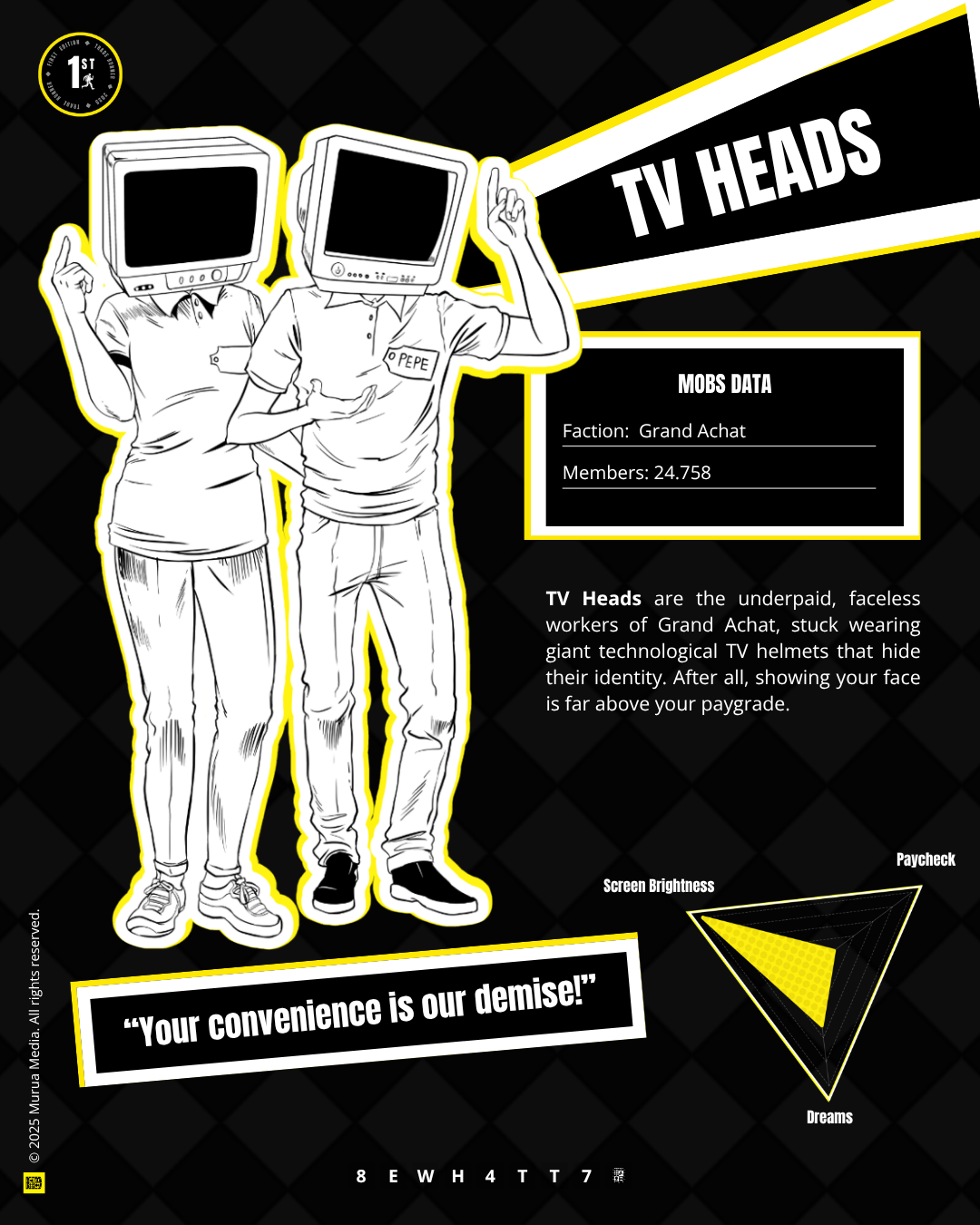
When we started designing the laborers of Grand Achat, we had one deceptively simple goal: make corporate anonymity visible. These are workers who signed away their names and identities to the waste’s largest electronics refurbishing franchise. How do you draw a person who has been erased?
The answer became the TV Head—a laborer wearing an oversized CRT cathode-ray helmet in place of a face.
The CRT Helmet
The cathode-ray helmet does the entire narrative job in a single silhouette. It’s bulky, industrial, and salvaged—an artifact of the same electronic scrap these workers are paid to sort. Wearing your own product as a mask is exactly the kind of grim corporate logic Grand Achat runs on.
Faceless by Design
No face means no individuality, and that’s the point. A TV Head isn’t Unit 802 because we forgot to name them—they’re Unit 802 because a name is a metric the company chose not to track. The design has to read as a person and a serial number at the same time.
Their labor reinforces it: sorting copper, silicon, and functional microprocessors out of endless electronic scrap piles, all under regional supervisorial checkups.
A face is a liability the company chose not to track. The helmet isn’t protection—it’s policy.
Under Supervision
Every TV Head exists inside a compliance hierarchy. Regional supervisors like the Branch 12 manager enforce strict quotas with zero tolerance, feared for their ruthless adherence to corporate metrics. The workforce design only lands because there’s always someone in frame with a clipboard and the authority to use it.
That tension—anonymous labor beneath merciless management—is the heart of Grand Achat. More dev-diary breakdowns coming as the series moves into production.